
Phase 5: The top self-levelling coating and EPDM. Where the system finally becomes a sports surface
10. August 2026
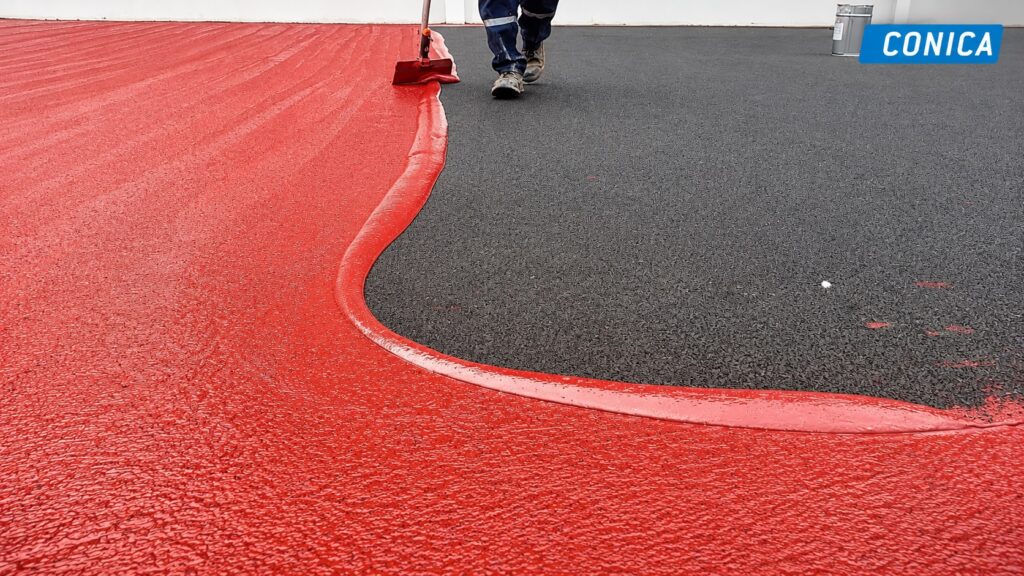
The application of the self-levelling polyurethane coating and the broadcasting of EPDM granules forms the final wearing layer of an in situ installed sandwich-system athletics track. It is the surface in direct contact with athletes and therefore ultimately determines key parameters such as traction, spike response, running comfort and durability under intensive use.
From the perspective of a manufacturer such as CONICA, whose systems are certified by World Athletics and used in both major international competitions and community facilities, this phase must be executed with the highest level of technical rigor. It is not merely a finishing layer: it is the final outcome of all previously completed construction phases.
Technical function of the self-levelling coating
The two-component self-levelling polyurethane coating is designed to:
- Provide controlled elasticity in combination with the elastic base layer
- Ensure a continuous, seamless surface
- Achieve optimum adhesion to the pore sealer
- Act as the binding matrix for anchoring EPDM granules
The coating is the most specialised layer in the entire system. It is also where the distinction becomes clear between manufacturers committed to professional systems and those merely completing a solution without giving it the same technical importance.
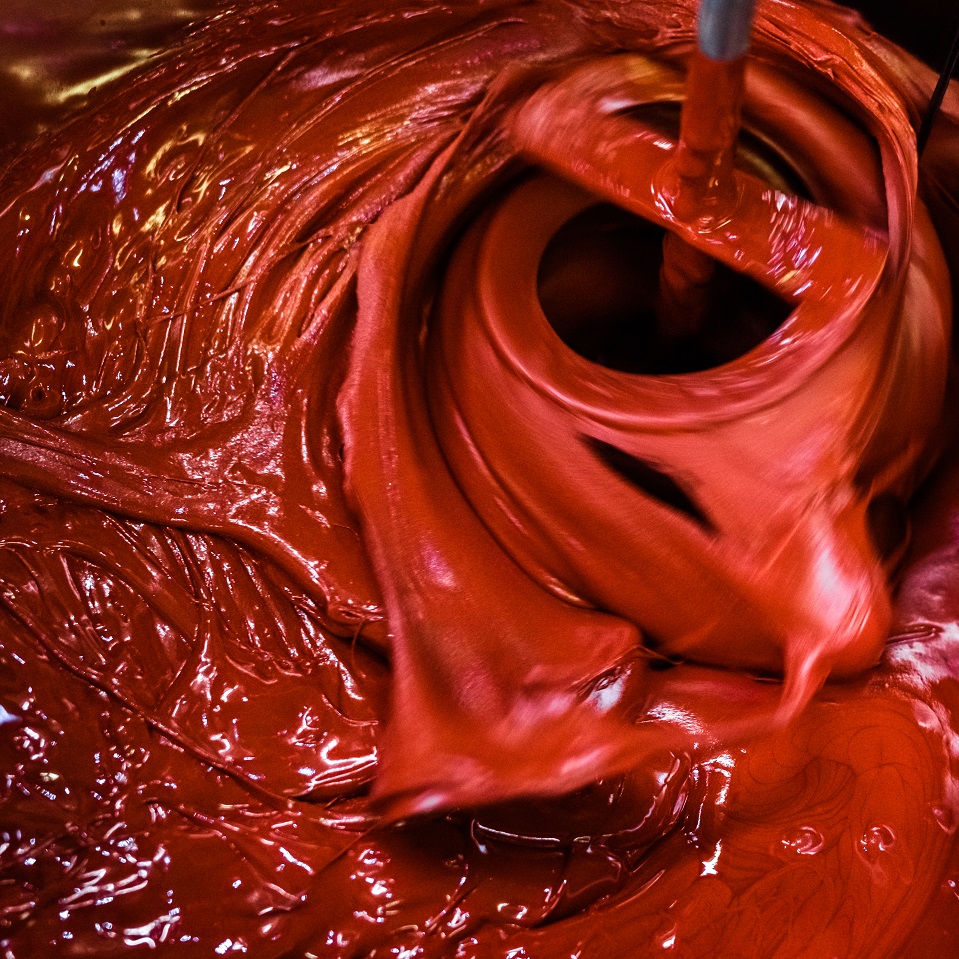
As noted above, the self-levelling polyurethane coating is only the final layer in a sandwich-type athletics track system. However, there are tracks with a 100% polyurethane construction, made up of different self-levelling coating layers containing SBR or EPDM granules in their base and intermediate layers as well. These athletics tracks offer a long service life, excellent life-cycle value and high technical performance developed for elite athletes.
A clear indication of CONICA’s specialist expertise in the athletics-track sector is the range of self-levelling coatings it offers: no fewer than seven different coating types, tailored to sporting and installation requirements, are available across CONICA’s athletics-track systems and layers.Most manufacturers offer a single type of self-levelling coating that is repeated across several layers of a 100% polyurethane track. This provides no differentiated technical qualities, and athletes can feel the difference. In future articles, we will look in greater detail at the different types of self-levelling coatings and the technical function they perform depending on their position and intended use within an athletics track.
A common characteristic of all CONICA coatings is their speed and quality of self-levelling. Literally within seconds, the coating develops its full levelling and surface-regularising properties, achieving the required levelness before the EPDM granules can be broadcast, while maintaining the technical characteristics needed to meet the relevant sporting parameters. This often impresses professional installers and remains a point of differentiation compared with other products on the market.
Coating application, timing and quality control
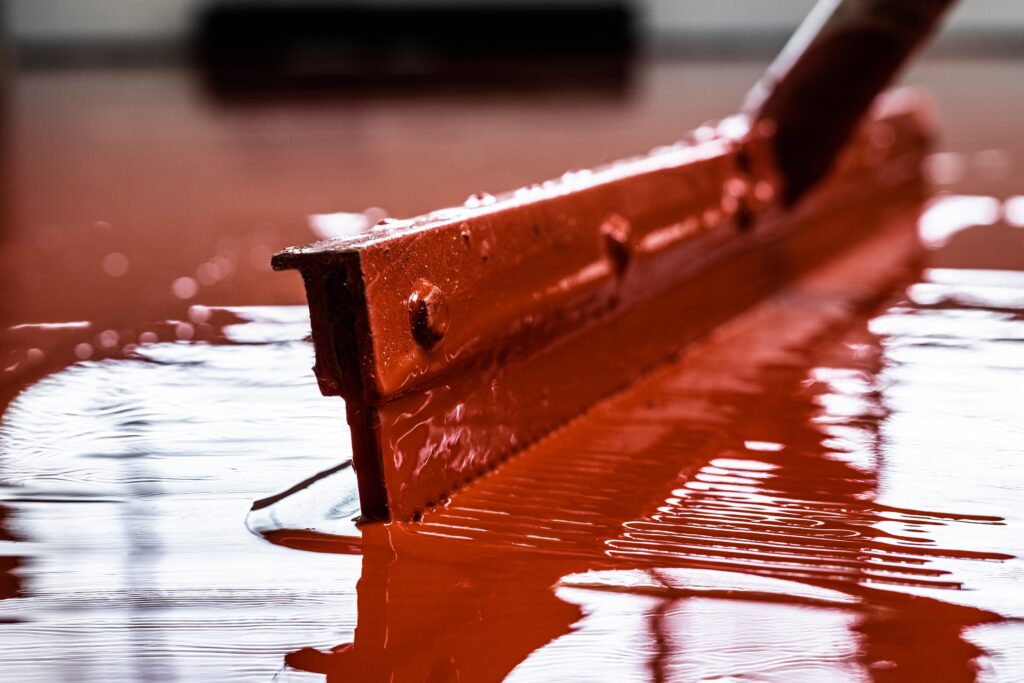
The self-levelling coating is a two-component product that must be homogenised before its components are mixed. Mixing must be carried out meticulously, observing the specified mixing times, using the appropriate mixer for each coating and continuously checking the quantities introduced at every stage, so that the material is in the ideal condition for application. It must be applied with notched squeegees, which may vary according to the type of coating and the quantity of material to be applied. All work must be performed by experienced personnel. Application must therefore follow the manufacturer’s specified thickness and application rate, considering:
- environmental conditions
- precise mixing times and workability windows
- the use of applicators or squeegees specific to each coating and layer thickness
as any variation directly affects the impact-absorption, vertical-deformation and wear-resistance values required under World Athletics standards and needed to obtain Class 2 or Class 1 certification.
Incorrect execution at this stage does not merely affect aesthetics: it directly compromises both certification and sporting performance.
Broadcasting EPDM granules: much more than color
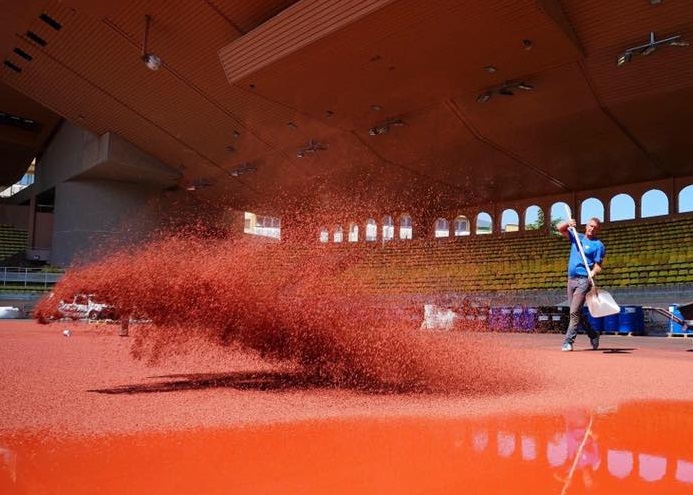
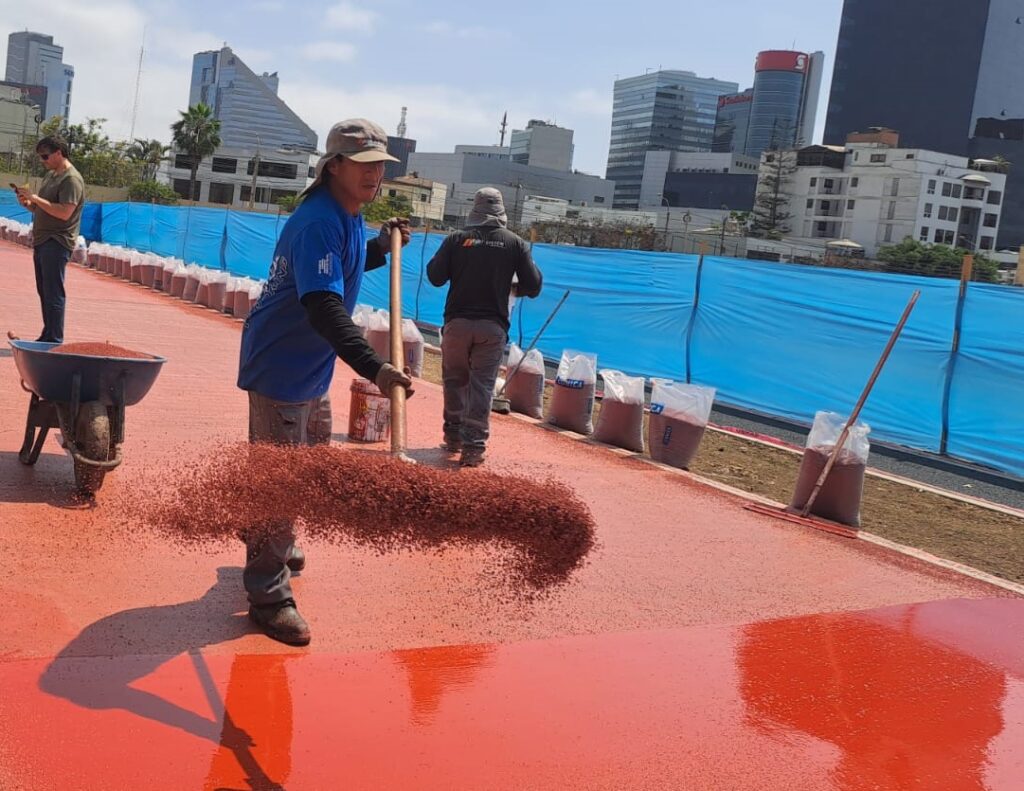
EPDM granules are broadcast in excess over the fresh coating. This defines the surface texture and its response to athletics spikes.Granules must always, always, always be broadcast in excess to ensure that no part of the surface remains without EPDM granules. The excess material also helps the granules integrate more effectively into the coating. Once the coating has cured, the excess is swept up, collected and reused on subsequent sections. If sufficient excess granules are not available during athletics-track installation, the area that can be coated becomes progressively smaller as the works approach completion, causing frequent interruptions and inefficient use of materials and installation crews.
The quality of the EPDM is absolutely decisive. High-quality granules must provide:
- high polymer content, ensuring elasticity and resilience
- a stable, controlled particle-size distribution
- resistance to UV radiation and weathering
- long-term colour stability
Lower-quality alternatives, often of Asian origin, are available with significantly lower polymer content, higher mineral filler content and inferior mechanical properties. They may initially appear equivalent and more economical, but over the medium and long term they produce harder surfaces, poorer spike response, accelerated wear and color loss, leaving a whitish appearance and causing claims only months after installation. High-quality EPDM granules are therefore indispensable. Reputable manufacturers supply and certify systems in which the granules are part of the certified scope of supply. Any polyurethane manufacturer that accepts EPDM granules from a supplier other than the one used for system certification should be treated with immediate caution: in the event of an incident or granule-related problem, no warranty claim will be accepted. All components must therefore come from a single source that assumes full system-warranty responsibility.
Advantages of the in situ system versus prefabricated surfaces
This phase particularly highlights the advantages of in situ installed surfaces:
- A fully continuous surface, without joints or seams
- Uniform performance across the entire track
- Better adaptation to the demands and wear caused by spike shoes
- Greater ease in carrying out future retopping, renewing the top layer without disturbing the base structure
- The possibility of extending the track’s service life and even recertifying it without having to renew the entire surface
In prefabricated systems, the presence of joints and the practical impossibility of renewing the surface limit durability and increase long-term costs. In the next publication, we will cover Phase 6: optional UV primer, line painting and the official markings for each event. Millimetre-level precision, durability and respect for system integrity. Where records are officially ratified.
If you are interested in this type of technical content about the world of sports surfaces, follow us on LinkedIn and stay up to date.
Weltklasse Zürich Lives Up to Its Name – The Night Records Fell on CONICA’s Piste Magique
ZÜRICH, SWITZERLAND – AUGUST 27: The podium at Diamond League: Weltklasse Zürich on August 27,…
Phase 6: optional UV sealing coat, line marking and the official markings for each event. Where world records are ratified.
Optional UV sealing of the surface Some granule colours are more sensitive to UV radiation…
Phase 5: the top self-levelling coating and EPDM. Where the system finally becomes a sports surface
From the perspective of a manufacturer such as CONICA, whose systems are certified by World…
A World Record Night on CONICA’s CONIPUR Vmax Track in Monaco
The Stade Louis II once again provided the setting for an exceptional night of international…
Phase 4: The Pore Sealer
Sealing, impermeability and system continuity Pore sealers are used in all sports surfacing systems with…
A New CONICA Athletics Track Beneath the Žižkov Television Tower in Prague
The project features the CONIPUR SP sports surface from CONICA, a proven system designed for…
Conica has been developing and manufacturing innovative seamless flooring solutions based on polyurethane and epoxy resins for sports, games, leisure as well as other areas for over 40 years. Conica is one of the world’s market leaders and innovation drivers in this field. The user-oriented requirements for technical and sports functional performance as well as usability while guaranteeing health aspects of the material itself and for the user are the focus of product development. Conica is part of the Serafin group of companies based in Munich.