Phase 6: optional UV sealing coat, line marking and the official markings for each event. Where world records are ratified.
10. August 2026
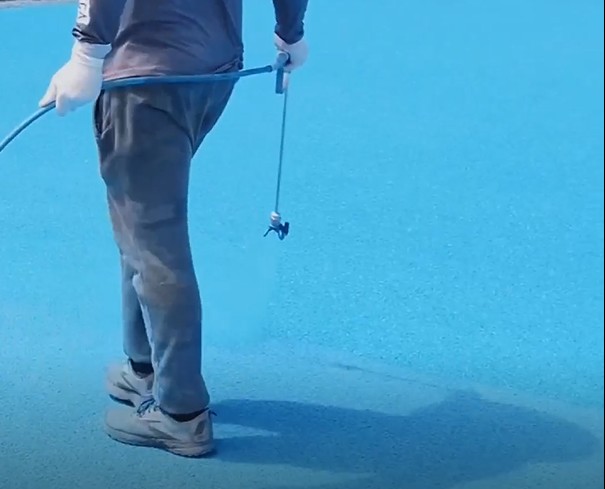
The different stages we have examined throughout the previous articles have brought us to the completion of the surface, with only the track lines still to be marked. However, in some cases we recommend an additional preliminary step: applying a UV sealer to the track. This treatment is particularly advisable in areas exposed to high levels of UV radiation. It is applied directly to the cured EPDM granule surface, before the lines are marked.
Optional UV sealing of the surface
Some granule colours are more sensitive to UV radiation than others. The traditional brick-red colour used on athletics surfaces generally withstands ageing and weather exposure very well, whereas other currently popular colours, such as light blue, purple and bright colour variations, tend to fade more quickly.
UV sealers are available to preserve colour intensity for much longer. They also provide additional benefits, including:
- Consistent colour and gloss – maximum UV protection
- Greater abrasion resistance
- Improved granule cohesion
- Reduced dirt absorption
- Improved rainwater drainage
- Reduced moss and algae growth
- Quick and easy cleaning
- Protection of the surface when the facility is used for other types of events
- A perfect, long-lasting gloss that even enhances the track’s appearance on television
This investment pays for itself within a relatively short time, particularly in areas with high UV exposure, as noted above.UV sealers are applied in the same colour as the surface granules. They can also be supplied with slip-resistant properties or antibacterial protection for areas where moisture frequently remains on the surface.
The final professional touch: line marking
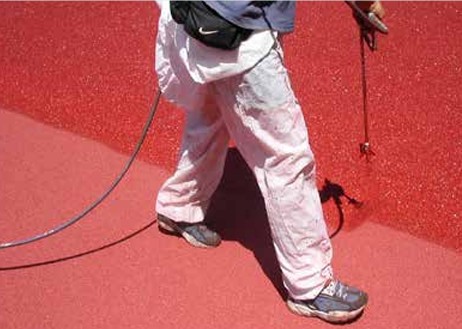
Applying the line-marking paint is the final stage in the construction of an in situ athletics track. It is often seen as a purely aesthetic or signage-related task. From a technicalstandpoint, however, it must be carried out with the utmost rigour, arguably even more than the rest of the system, because it affects durability, athlete safety and regulatory compliance. More importantly, an error in the line marking would create a serious problem and be costly to rectify. The marking specialist must therefore have extensive experience, particularly when the track is to be certified.
Precision work worthy of a Swiss watchmaker
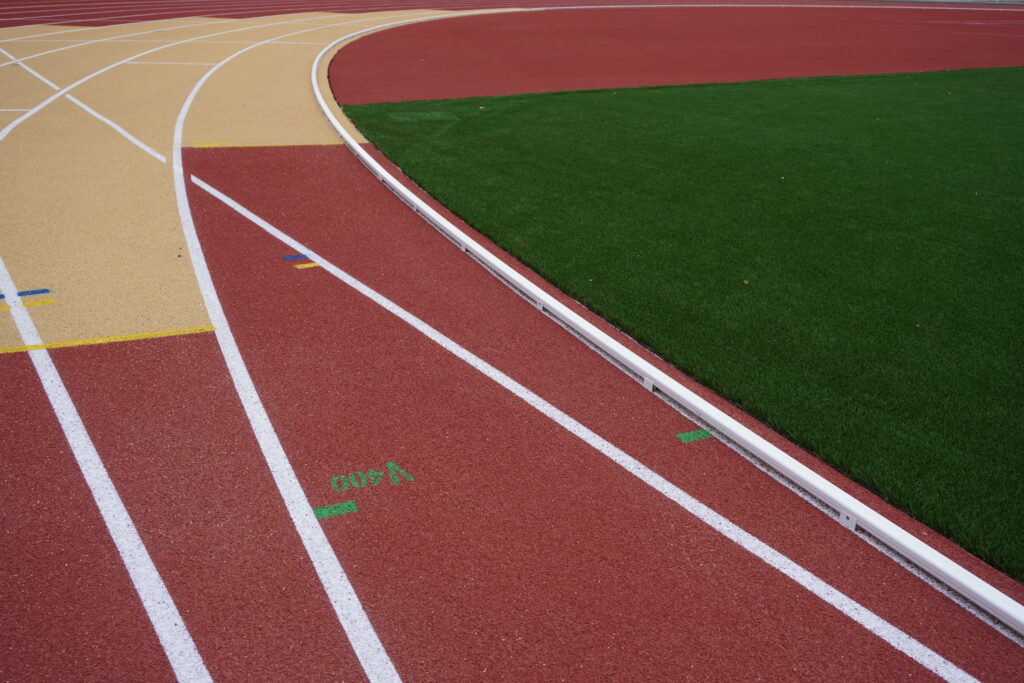
Athletics tracks require a range of markings that go far beyond the longitudinal lane lines and start or finish lines. Many of you will be familiar with the lines and markings found on an official athletics track, but let us briefly review everything that must be considered at this stage to illustrate the complexity of the task:
1. Longitudinal lane-separation lines
2. Finish line
3. Start lines: straight starts, staggered lane starts, compensated curved starts and colour-coded starts (with a coloured central segment)
4. 4 × 100 m relay takeover zones
5.4 × 400 m relay takeover zones
6. Breakline
7. Breakpoint for group starts: in some long-distance races, athletes may be divided into two groups. One group starts from the inner line and the other from an outer curved line. The point at which the outer group may merge with the inner group is known as the breakpoint.
8. Hurdle-position markings
9. Steeplechase markings
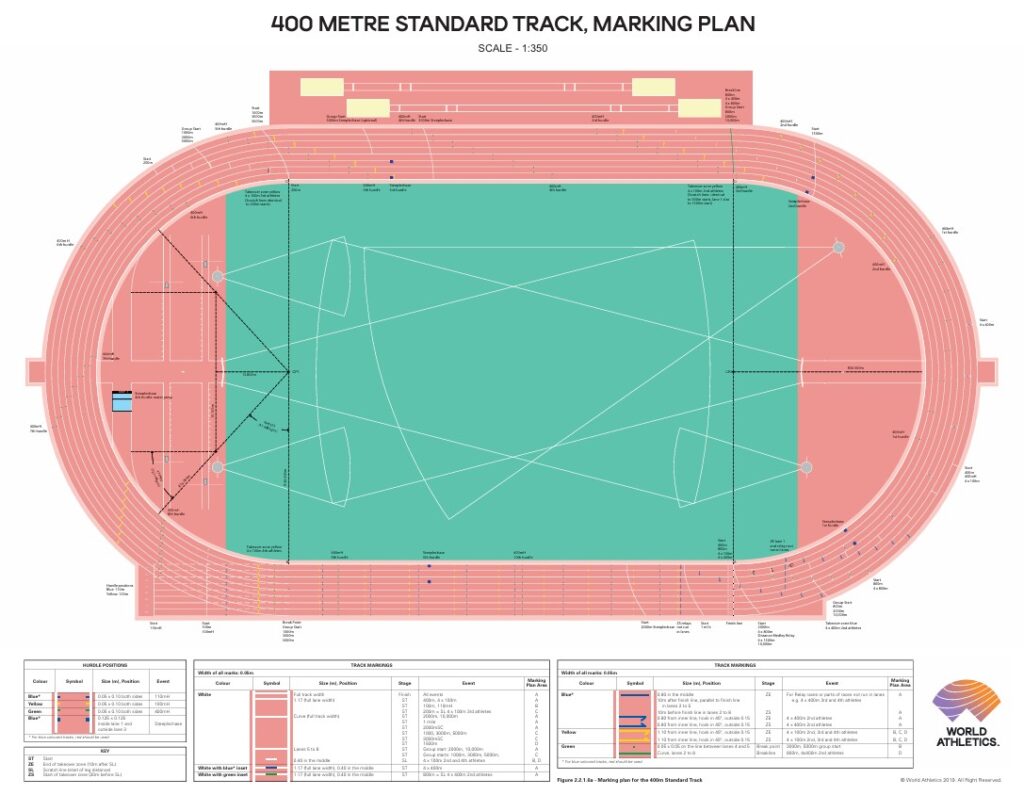
There are also additional marks, including auxiliary and survey-control marks. What does this include? These are markings that do not directly identify an event but are required for setting out, certification or track operation, for example:
- Tangency points between straights and bends: distinctive 0.05 × 0.05 m marks on the inner line.
- Radius-change points on double-radius tracks.
- Concealed reference points, or references located beneath the kerb, to reconstruct the markings after retopping.
- Small black rectangles next to the finish line, up to 0.05 × 0.02 m, which provide contrast for the photo-finish system.
- Temporary markings for relay events or age categories that should not be permanently painted
Had you considered that all these markings exist? Most spectators, and even many professionals involved in athletics, are unaware of them and assume that marking a track is a quick job. In reality, it is a highly complex task that demands extreme precision andleaves no room for error. This is why the number of professionals worldwide capable of marking certified tracks can be counted on the fingers of two hands.On World Athletics-certified tracks, such as those built with CONICA systems, line marking is not an accessory element. It forms part of a high-performance sports surface and must be properly integrated with the wearing course.
Technical function of line marking
Line-marking paint must meet several requirements simultaneously:
- High adhesion to polyurethane surfaces with EPDM
- Durability under foot traffic, intensive use and weather exposure
- Chemical compatibility with the wearing course
- Geometric accuracy in accordance with the prescribed dimensions
An unsuitable or poorly applied paint system may lead to flaking, loss of line definition or areas with inconsistent performance, particularly at starts, finishes and on bends.
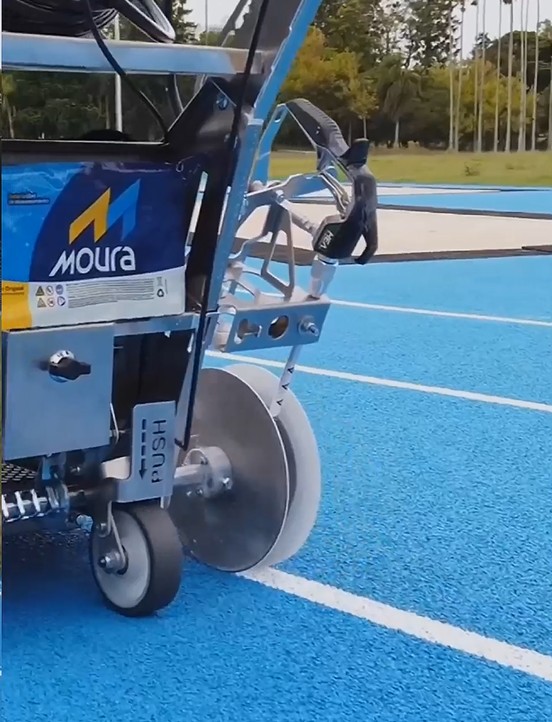
The importance of high-quality two-component line-marking paintFor in situ athletics tracks, the line-marking paint should be a two-component polyurethane product specifically formulated for outdoor sports surfaces.
This type of product provides:
- Greater mechanical resistance
- Improved UV resistance
- Colour stability
- Excellent adhesion to EPDM surfaces
- Correct mixing and application within the specified pot life
Although acrylic paints, water-based paints or generic products may initially appear more economical for athletics track lines, they generally result in premature wear and frequent repainting. This increases maintenance requirements and creates additional costs, particularly given the large number of markings required on a track, as we have already seen.
Surface preparation and application conditions
Before painting, the surface must be clean and dry, and free from dust, loose granules and other contaminants.Environmental conditions are once again critical. Temperature, humidity and dew point directly affect curing and paint adhesion. A professional approach requires these parameters to be monitored, and the application process adjusted accordingly.
Application using specialised machinery
To guarantee marking accuracy and uniformity, the paint must be applied using dedicated line-marking equipment capable of ensuring:
- Consistent line widths
- Clean, sharply defined edges
- Uniform thickness
- Repeatability throughout the entire track
Manual application without suitable equipment increases the risk of irregularities and deviations from the regulatory dimensions required by World Athletics.
Relationship with track durability and service life
Properly executed line marking helps to:
- Keep the markings clearly legible for longer
- Reduce maintenance operations
- Preserve the integrity of the wearing course
In addition, on in situ systems the line markings can be renewed or adapted during future interventions, particularly as part of a retopping, without replacing the entire surface. This further improves the sustainability and cost efficiency of the system.
Certified applicators and final assurance
As with all previous stages, and even more so when it comes to line marking and additional markings, we emphasise that this work must be carried out by certified applicators to achieve an excellent result and support the track certification. Only in this way can the finished track genuinely meet the client’s expectations and the technical and sporting standards required of a modern athletics facility.
Line marking is the final visible step, but it also symbolises the completion of a properly executed process. When every stage has been carried out correctly, the result is a seamless, durable and certifiable track, ready to serve athletes for many years.
This stage concludes our CONSTRUCTION OF AN ATHLETICS TRACK STEP BY STEP series. In forthcoming articles, we will explore other important topics and possibilities in the world of athletics tracks, including partial track refurbishment and retopping solutions designed to extend the service life of athletics surfaces.
Weltklasse Zürich Lives Up to Its Name – The Night Records Fell on CONICA’s Piste Magique
ZÜRICH, SWITZERLAND – AUGUST 27: The podium at Diamond League: Weltklasse Zürich on August 27,…
Phase 6: optional UV sealing coat, line marking and the official markings for each event. Where world records are ratified.
Optional UV sealing of the surface Some granule colours are more sensitive to UV radiation…
Phase 5: the top self-levelling coating and EPDM. Where the system finally becomes a sports surface
From the perspective of a manufacturer such as CONICA, whose systems are certified by World…
A World Record Night on CONICA’s CONIPUR Vmax Track in Monaco
The Stade Louis II once again provided the setting for an exceptional night of international…
Phase 4: The Pore Sealer
Sealing, impermeability and system continuity Pore sealers are used in all sports surfacing systems with…
A New CONICA Athletics Track Beneath the Žižkov Television Tower in Prague
The project features the CONIPUR SP sports surface from CONICA, a proven system designed for…
Conica has been developing and manufacturing innovative seamless flooring solutions based on polyurethane and epoxy resins for sports, games, leisure as well as other areas for over 40 years. Conica is one of the world’s market leaders and innovation drivers in this field. The user-oriented requirements for technical and sports functional performance as well as usability while guaranteeing health aspects of the material itself and for the user are the focus of product development. Conica is part of the Serafin group of companies based in Munich.